Tradition vs Progress
At my last Nerd Nite, I closed off the year with this icebreaker question:
What is more important to you:
Preserving history and traditions or future planning and progress?
I knew it was an ask that would stir up some discomfort in the audience, as most critical thinking questions do. Many did not want to choose, or could not decide. Can’t we have both? I assured the crowd that the question really doesn’t have a right answer. I enjoy using the show I host to learn more about people as well as attempt to get people to dig a little deeper in themselves.
A couple people emphasized the importance of history. One pointed out that though they thought history was important, preserving traditions could mean continuing harmful ones as well as positive and important ones, such as indigenous practices. How do we filter what to keep?
Another person commented that if we follow tradition, it will dictate future planning. Bada-bing Bada-boom. Work done.
Generally the crowd agreed that history and tradition was more important. I asked if there was anyone who values future planning and one person made themselves known. She quipped that in order for change to happen, future planning would be necessary for that progress.
I ask these questions and mostly keep a neutral stance on stage as my role there isn’t to spread my views as much as it is to facilitate thought and discussion. Facilitate the nerding out. I have been warming up my regular crowd though for deeper discussion over this season’s shows.
Other previous icebreakers:
- Does your personality inform your experiences or does your experiences inform your personalities?
- Order these words of “big” smallest to biggest: gigantic, large, big, enormous, huge, ginormous, massive
See what I’ve been doing there? ;)
It feels mischievous but I don’t really think it is. Nerding out includes philosophy and these icebreakers have been a bigger hit than the previous repetitive one we had been asking before: “what have you been nerding out about lately?”
I digress...Back to the OG topic Tif!
For me, the value in history and traditions is in retaining accumulated knowledege and transferring wisdom that can benefit future generations. That does not imply the way future generations benefit is fair and compassionate. We humans are tricky that way. From what I observe, humans want the benefit to befall on only who they consider part of "their" clan. (enter discrimination, prejudice, and oppression).
Historical knowledge also fulfills a sentimental desire to be connected to our ancestors. I believe our curiousity of knowing about "our lineage" is fueled by the desire to know oneself, and the belief that knowing our anestry induces a sense of identity for us. People relish in identifying facial features that they recognize in their relatives and children.
Traditions serve as the activities passed down that facilitate a sense of knowing and connection. Some traditions indeed hold wisdom, and when they do hold true wisdom, it serves not just a group of people, but all. However, I believe it is harmful to hold tightly on to traditions without criticism as many "traditions" are violent, biased and serve only a small group of people. They serve to maintain elitism through oppression. From what I have learned, true wisdom is universal brings all people together. So I personally am cautious about what and how I let dead people dictate my life.
Examples of Harmful Traditions
- Binding of women's feet in China
- Honour killings
- Widowhood rites
- Forced marriages
- Slavery
- Genital Mutilation
Hmm... do we see a pattern here of who the traditions apply to...
The nuanced part where whether traditions are violent is when traditions the part w may have actions that mimic violence (against women and children), such as pomlázka, a Czech custom held on Easter Monday which involves men and boys playfully whipping women with a special braided willow switch. This action was meant to bring health and fertility to women. However, some women find this event uncomfortable.
Somehow I'm moving on to Ethics now...
(but it's my blog so I'm going to do what I want to)
I use enthusiastic consent as a way of determining if the action is violent or just. Similarily, I think enthusiastic consent could be applied to any situation to judge if it violates humanity.
Let's use eating an apple as an example. I know my friend Jo likes apples so I give them an apple. Jo usually loves eating apples but just finished an apple pie and is full, so they don't want to eat the apple. Thus, they politely decline to the offer of the apple. Here is where the HOW determines whether there is enthusiastic consent or coercion or force.
Scenario 1: I tell Jo "okay" and let them know the apple is for them and available for them to eat whenever they want, even if it's later at their home. After 20 minutes, Jo feels a tug to bite into the juicy delicious homegrown apple and decides to take a nibble.
Scenario 2: I feel offended because the apple is from my backyard and is special to me, so I express that I really want Jo to eat the apple. Jo feels bad even though they are really full. I start to cry. Jo feels even worse that I'm crying and doesn't want to lose me as a friend. They reluctantly bite into the apple even though they really don't want to.
Scenario 3: I really want Jo to eat the apple. I don't feel good that Jo won't eat the apple so I manually open Jo's mouth and stuff the apple in.... or maybe I point a knife at Jo and say "eat the apple" in a menacing Arnold Schwarzenegger Terminator voice.
Jo eats the apple.
Scenario 1 allows for choice. Scenario 2 isn't quite overt force, but it is pressure and coercion. Scenario 3 is violent force.
Coercion and violent force are forms of oppression. One is driven by manipulation and the other by brutality. Coercion is shitty, but it happens all the time. Neither work very well. It's like when my mom used to tell me I had to be friends with certain kids. The result was most certainly I would not be friends with those kids. No one wants to act against their true will. Forcing people to do things, including follow traditions, sucks...and so does coercion.
So I use this approach to apply to tradition...and many scenarios of life descsions. Does the subjected person enthusiastically consent to the action/activity?
My approach to history, tradition, future and progress
The value of attachment to direct blood lineage shifts a bit for me when I start thinking about my body as a flesh container and slough my value affixed to demographic markers as who I am. Stuff I am continuously in the process of investigating and exploring as I question my identity.
There really is no other time I want to be alive except now and maybe in the future. I'll stick to now though. Any given time in the past, I was more restricted, oppressed and disempowered. So as dysfunctinal as the world is now, there was dysfunction before as well and I believe I would likely have been in a worse position.
More than safeguarding history and tradition, I value the passing down of wisdom so that people now and in the future can progress towards a healthier, kinder, more equitable way of existing. Perhaps that lands me more on the side of future and progress, but that is still not possible without the wisdom of now and before. I believe it's what we do with history and tradition, and how we choose to use the knowledge to plan for the future that determines the type of progress we will have.
Artistic Statments with Historical Artifacts
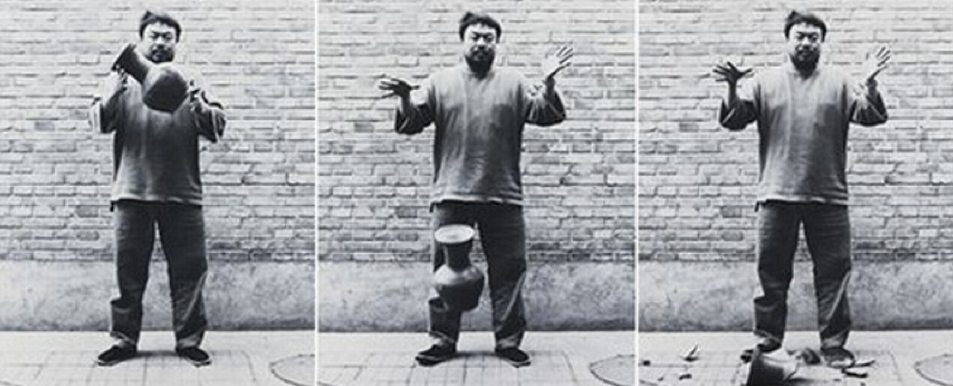
Two artists I recently have been researching, Ai Weiwei and Ulay, both created pieces that utilize "violence" against historial artifacts as the central element of their art pieces. The commotion conjured was only possible because the historical artifacts they used were prized pieces of history. It beckons the question for me, it it the material we value or what it represents? Mockumentary Treasures from the Wreck of the Unbelievable challenges that very notion and our perception of authenticity.
Ai Weiwei's dropping of a 2000 year old ceromonial urn provoked a lot of people, especially antique collectors. This piece confronted China's rapid modernization which inevietably initiated a lot of cultural upheaval. Was destruction of history necessary for progress? China has a contentious history of cultural destruction and when criticism faced Ai Weiwei for destroying historical artifacts, he countered the outrage by reminding them of General Mao's saying "The only way of building a new world is by destroying the old one."
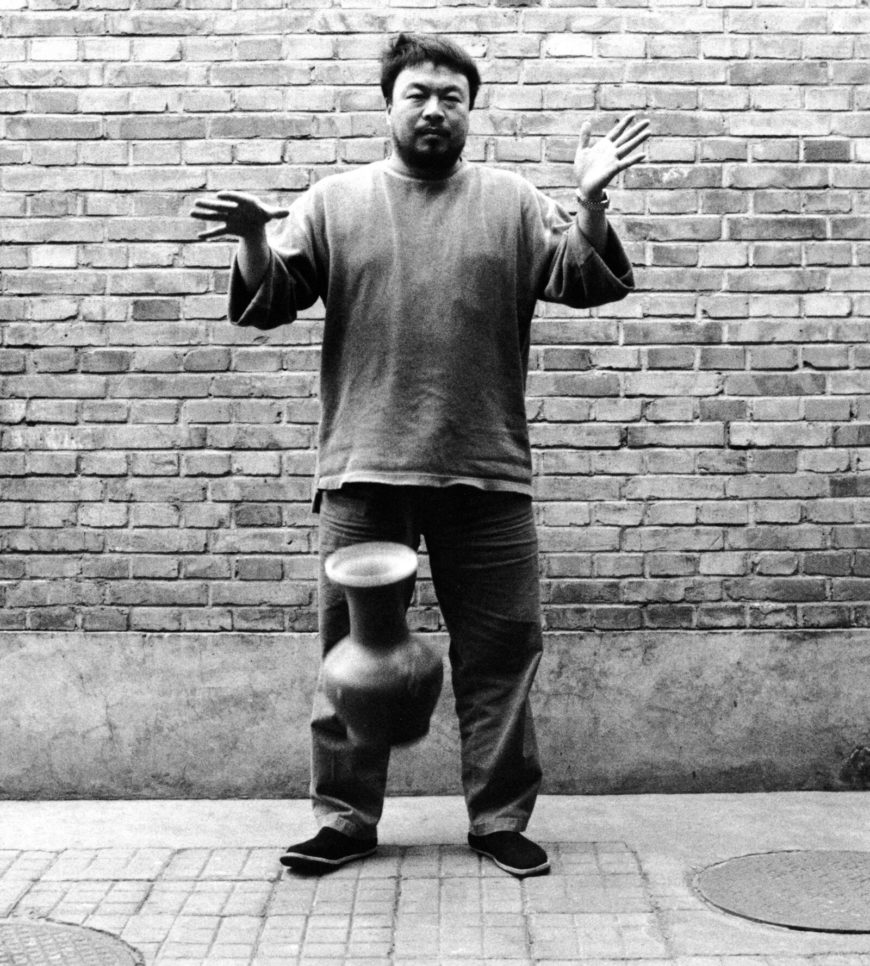
Ai Weiwei dropping a 2,000-year-old ceremonial urn worth thousands of dollars (source:https://smarthistory.org/ai-weiwei-dropping-a-han-dynasty-urn/)
Some say Ai Weiwei's Dropping a Han Dynasty Urn can also be interpreted as his attempt to rework past art into present art and giving these antiques a second life. This perspective, on the contrary, is one of reconstruction and preservation.
Ulay, the artist who stole art for art
Performance artist and Polaroid consultant, Ulay, stole Hitler's favourite artwork as an act of art. In 1976, he planned and designed the piece Irritation – There is a Criminal Touch to Art, which involved him stealing the painting The Poor Poet (1839) by Carl Spitzweg from the Neue Nationalgalerie in Berlin. It involved him dashing off with the famous painting, driving to Kreuzberg, a segregated community of Turkish immigrants, and hanging it in a Turkish family's home. He called the police and Professor Honisch, director of the galerie at the time, to inform them of his crime. Ulay got off the crime with a night in jail after making the statement "...this was a demonstrative action, not a theft in the traditional sense.” Ulay explained it as a “protest action, first of all against the institutionalization of art, secondarily about discrimination against foreign workers.”
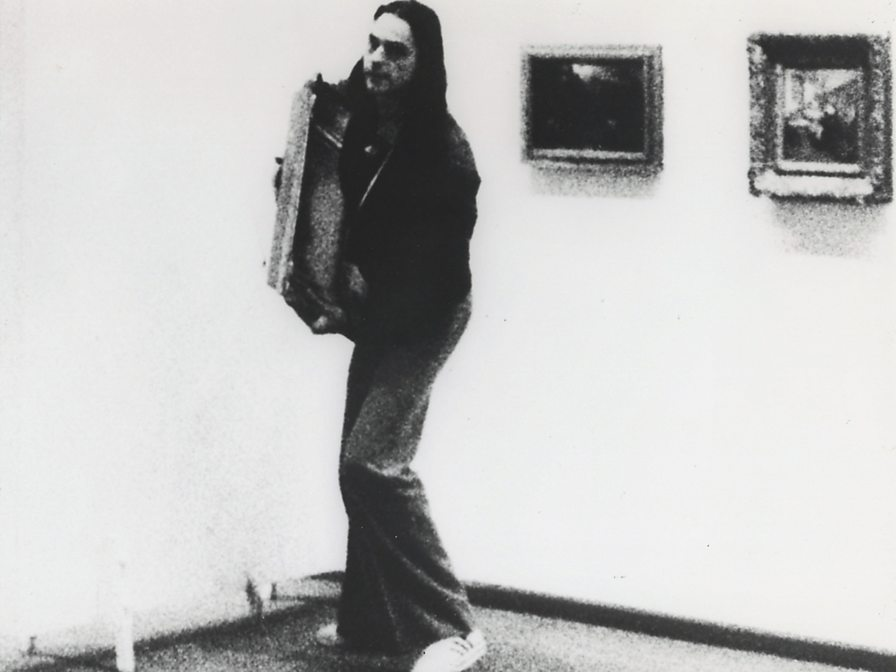
Ulay Interview: How I Stole a Painting
Other artists who challenged history I want to learn more about : James Luna, Guerilla Girls, Frida Kahlo, Georgia O'Keefe...
(Ulay image sources: https://www.bbc.co.uk/programmes/articles/2MHtZhL6K721QYxVccW2FdS/the-gender-identity-pioneer-who-stole-hitler-s-favourite-painting)